
If you live in a two-story home and someone in your family uses a wheelchair or a walker, you already know the daily struggle. Every trip up or down the stairs becomes a moment of worry. You wonder who will be there to help, whether the brakes will hold, and whether today is the day something goes wrong. It is exhausting, and it is exactly the kind of problem most people do not talk about until it is right in front of them.
The good news is that there is a practical answer: a lift that carries the whole wheelchair, user and all, straight up the staircase. No transferring into a separate seat, no folding the chair, no relying on someone else’s strength. In this article, we walk through why inclined platform wheelchair lifts are ideal for home accessibility, what to look for, and the figures that actually matter when you compare one.
What Exactly Is an Inclined Platform Wheelchair Lift?
Put simply, an inclined platform wheelchair lift is a motorized platform that rides along a rail fixed to the staircase. The user wheels onto the platform, locks it in place, presses a button, and the platform travels up or down the slope while the user stays in the chair. Because the rail follows the angle of the stairs, the lift works on straight flights, L-shaped turns, and even curved staircases without taking up floor space.
The main difference from a stair chair lift is that you stay in the wheelchair the whole time. That single feature makes a huge difference for people who cannot safely transfer between the wheelchair and a small seat, or who are simply too heavy to be lifted manually by a caregiver.
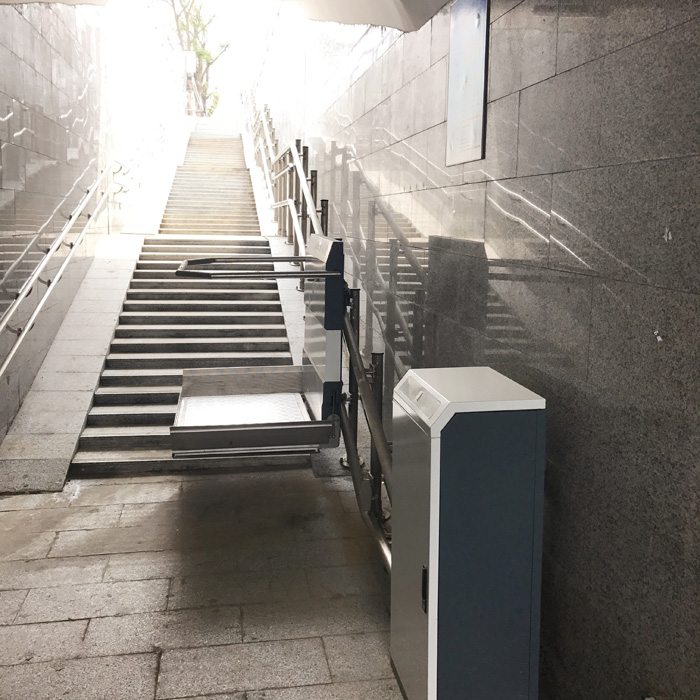
Why People Choose a Platform Lift over a Stair Chair
Most homeowners start by comparing a platform lift with the more common stair chair. The choice usually comes down to two things: whether the person can transfer, and how much space the device needs.
A stair chair takes up little room and is cheaper, but it requires the user to move from the wheelchair into a narrow seat. For many elderly people or those with limited trunk strength, that transfer is the hardest and riskiest part of the whole journey. An inclined platform wheelchair lift removes that step completely. The wheelchair stays under the user, which also reduces the chance of falling during the move. In homes where caregiving falls on one or two family members, this one difference often decides the purchase.
Key Specifications to Compare Before Buying
Once you decide a platform lift makes sense, the numbers matter more than the brochure. Here are the figures we think are worth checking first.
| Specification | Typical Range | Why It Matters |
|---|---|---|
| Safe Working Load | 250 – 350 kg | Determines whether the lift can carry the user plus the wheelchair weight together |
| Platform Width | 700 – 900 mm | A wider deck gives more clearance for larger wheelchairs |
| Max Travel Height | 6 – 15 m | Sets the limit for taller staircases and multi-story homes |
| Travel Speed | 0.08 – 0.15 m/s | Slower speeds feel safer and reduce start-stop jerk |
| Rail Type | Straight / Curved / Turn | Curved rails allow L- or U-shaped staircases |
| Power Supply | 230V AC, backup battery | Battery backup keeps the lift working during a power cut |
| Noise Level | Under 60 dB | Quieter units cause less disturbance in a family home |
| Safety Features | Obstruction sensor, manual descent, footrest guard | Protect the user and anyone standing nearby |
These are not marketing talking points. They are the practical details that decide whether the lift fits your staircase and whether it will still be safe in five years.
Safety Features That Matter Most at Home
Safety is where an inclined platform wheelchair lift earns its keep. Look for a few essentials before you commit.
First, an obstruction sensor that stops the platform if anything blocks its path. Second, a manual descent option, so the unit can be lowered even if the power fails. Third, a footrest guard and a folding ramp edge, because small gaps are where wheelchairs catch. Fourth, a low noise level, which matters more in a home than in a commercial building. Each of these protects a different part of the journey, and together they turn a mechanical ride into a genuinely reliable one.
Installation and Space Considerations
A platform lift does not take away your staircase. The rail mounts along the wall or the treads, and the platform folds when not in use so the stairs stay usable for the rest of the family. Installation time usually runs from a single day for a straight flight to several days for a curved run. You will also want to keep a small amount of clear space at the top and bottom of the stairs so the platform can open and close safely.
Because every staircase is different, the most honest advice is to measure the travel height, the available width, and the landing space before you choose. A unit that fits a commercial lobby may be too large for a domestic hallway, and vice versa.
Cost, Maintenance, and Long-Term Value
Budget is usually the deciding factor, and it is worth being honest about it. An inclined platform wheelchair lift is a larger investment than a stair chair, largely because it carries more weight and uses heavier components. Running costs are modest, but a yearly service is a good habit. Regular checks on the rail, the drive motor, and the safety sensors will catch small problems before they become big ones.
For most families, the real return is not measured in money. It is the independence it gives back, and the peace of mind that comes from knowing a family member can move between floors without waiting for help.
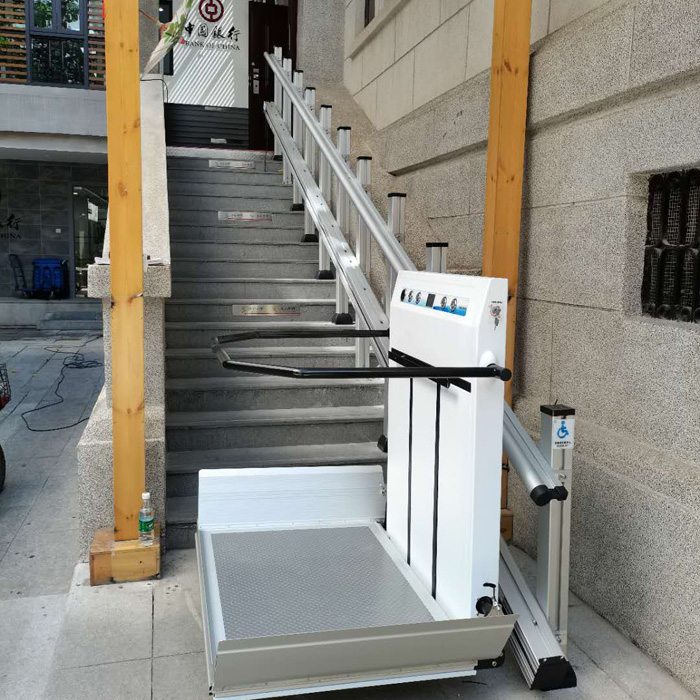
Frequently Asked Questions
1. Do I need to get out of my wheelchair to use an inclined platform wheelchair lift?
No. The whole point is that you stay seated in the wheelchair. The platform locks the chair in place and carries both together up or down the slope.
2. Can an inclined platform wheelchair lift handle a curved staircase?
Yes, as long as the unit is built with a curved rail that matches your staircase. Curved systems take longer to install but handle L-shaped and U-shaped layouts well.
3. What happens during a power outage?
Most models include a battery backup and a manual descent function, so the platform can still be lowered safely even when the mains supply is off.
4. How much maintenance does it need?
A professional service once a year is usually enough. Daily checks are simple: make sure the platform is clean, the rail is free of debris, and the safety sensors respond.
5. How long does installation take?
A straight flight often takes about a day. A curved or turning staircase can take several days because the rail must be carefully shaped and fitted.