
Core Selection Criteria for Safe and Durable Curved Wheelchair Lifts
Picking accessibility equipment is very different from buying ordinary home appliances. Safety, stability and long-term durability must always come first. Many homeowners make the mistake of focusing only on price or appearance, ignoring core technical parameters and safety configurations that directly affect user protection. A qualified curved wheelchair lift needs to meet standardized load capacity, stable operating performance and complete safety mechanisms, especially for long-term daily use by seniors and people with limited mobility.
To help buyers make objective comparisons, below is a verified technical parameter table covering mainstream home wheelchair lift standards, referencing industry accessibility specifications and mainstream product design requirements:
|
Technical Parameter
|
Standard Home Specification
|
Premium Durable Specification
|
Safety Requirement
|
|---|---|---|---|
|
Rated Load Capacity
|
250kg (550lbs)
|
300kg (660lbs)
|
Meets ADA residential load standards
|
|
Operating Speed
|
0.10–0.12 m/s
|
0.08–0.10 m/s
|
Low speed for stable, jolt-free movement
|
|
Safety Factor of Structural Parts
|
≥5:1
|
≥6:1
|
Prevents component fatigue and breakage
|
|
Working Temperature Range
|
0°C – 40°C
|
-20°C – 50°C
|
Adapts to seasonal temperature changes
|
|
Standard Warranty Period
|
12 Months
|
24–36 Months
|
Guarantees long-term after-sales support
|
Prioritize Certified Safety Mechanisms
Safety is the non-negotiable foundation of any mobility lift. High-quality curved wheelchair lifts are equipped with full-range safety protection systems. Key features include anti-collision obstacle sensors that automatically stop operation when barriers are detected, overspeed governors to prevent sudden sliding, and emergency stop buttons for unexpected situations. For elderly users with slow reaction speeds, these layered protections effectively avoid accidental injuries during daily use. Additionally, reliable braking systems can lock the platform instantly on curved track sections, ensuring stable parking on inclined and bent stair paths.
Verify Custom Track Adaptability
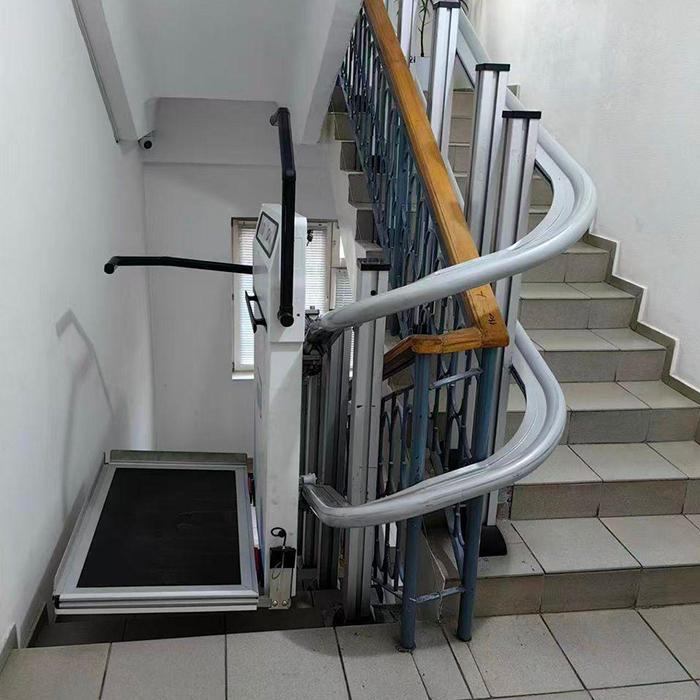
Unlike straight stair lifts with fixed rails, curved stair structures vary greatly in turning radius, bend angle and stair width. Generic standard tracks cannot fit most custom curved staircases. A durable lift solution requires fully customized rails that precisely match the home’s stair curvature and landing layout. Professional manufacturers conduct on-site measurements to design exclusive track bending angles, ensuring smooth operation without jitter or friction during ascent and descent. This customized design also reduces long-term wear and tear, extending the equipment’s service life significantly.
Check Material and Weather Resistance Durability
Most home mobility lifts serve users for 10 years or longer, so structural material quality determines long-term stability. Premium models adopt high-strength steel tracks and anti-rust treated frames, avoiding deformation, rust or aging after long-term indoor use. For semi-outdoor installation environments, weather-resistant materials can resist ultraviolet radiation, temperature changes and humid air, maintaining consistent operating performance in all seasons. Inferior thin steel or unprocessed materials are prone to structural fatigue, leading to shaking or abnormal noise after several years of use.
Confirm User-Friendly Control Design
Elderly and disabled users often have limited hand strength and flexible response capabilities. Excellent accessibility equipment simplifies operation while ensuring safety. Qualified lifts come with large physical buttons, low-operation-force control panels and wireless call keys for upstairs and downstairs dual control. Some upgraded models add intelligent slow start and slow stop functions, eliminating sudden jolts that may cause user discomfort or safety risks. Simple and intuitive operation greatly reduces the threshold for elderly users to independently use the equipment.
Practical Buying and Installation Tips
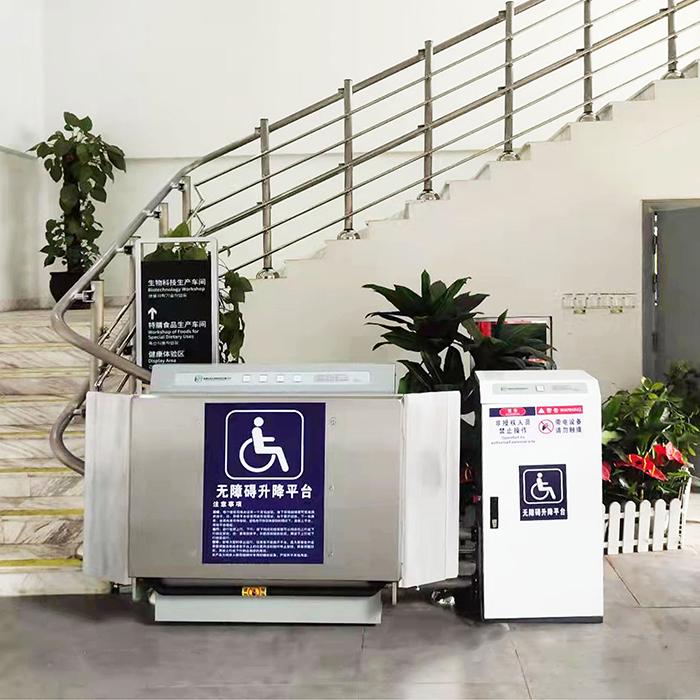
Many users only focus on product parameters but ignore standardized installation and after-sales service, which leads to hidden safety hazards in later use. Curved stair lift installation belongs to professional customized engineering, requiring precise structural fixation and circuit debugging. It is essential to choose certified installation teams with rich experience in curved stair projects. After installation, professional personnel need to conduct load testing, safety function debugging and operation training for users to ensure every protection mechanism works normally.
Regular daily maintenance is also key to extending equipment life. Users only need to keep the track clean, avoid hard object extrusion, and arrange professional inspection and lubrication every six months. Scientific maintenance can effectively reduce component wear and keep the lift operating stably for a long time.
Frequently Asked Questions
Q1: Are curved wheelchair lifts suitable for all types of curved stairs?
Most household curved and spiral stairs can be adapted through customized track design. Professional manufacturers complete on-site measurement and personalized rail bending design according to stair turning radius, width and height differences. Only extremely narrow or irregular special-shaped stairs may require structural adjustment before installation.
Q2: What is the average service life of a qualified curved wheelchair lift?
With standardized installation and regular maintenance, high-quality equipment can stably serve 10–15 years. Core structural tracks and braking components have strong durability, while wearing parts can be replaced regularly through after-sales service to ensure long-term safe operation.
Q3: Is professional installation mandatory for this equipment?
Yes, professional installation is essential. Curved track positioning, structural fixation and safety debugging require professional technology and tools. Self-installation or non-standard construction may cause track deviation, failed safety mechanisms and even operational risks. Formal manufacturers provide one-stop measurement, installation and commissioning services.
Q4: What safety checks should be done daily before use?
Users can simply check for abnormal noise during operation, confirm the flexible response of the emergency stop button, and ensure no obstacles on the track. Regular professional inspections cover braking performance, sensor sensitivity and circuit stability to eliminate potential faults in advance.