
Moving boxes, inventory and equipment between floors is a routine headache for many commercial spaces. Staff often carry heavy items up and down stairs, which leads to slips, strains and dropped goods. Many business owners start looking at a cargo stairlift as a practical fix, but the first question is always safety. When you run deliveries, restocking or daily material handling, can this equipment hold up day in and day out without risk? The short answer is yes, but only when it is matched to your space, load type and usage schedule. Safety is not built into the machine automatically; it comes from correct sizing, certified installation and consistent checks.
Core Safety Features That Support Regular Commercial Operation
A unit designed for commercial duty includes layers of safety controls that stop accidents before they start. Most reliable builds use constant-pressure operation, meaning the platform only moves while an operator holds the control. If the button is released, the system stops immediately. Anti-collision sensors along the platform edge detect obstructions and cut power right away, preventing damage to the lift, stairs or stacked goods. Mechanical braking acts as a backup, holding the load steady even if power is lost.
These numbers are general benchmarks. Curved stairwells, longer rail runs or uneven step geometry often reduce the safe working load. The installation assessment should document stair structure, wall anchoring points and clearances around landings. Even a well-built cargo stairlift becomes unsafe if the mounting surface cannot handle repeated dynamic loads from daily trips.
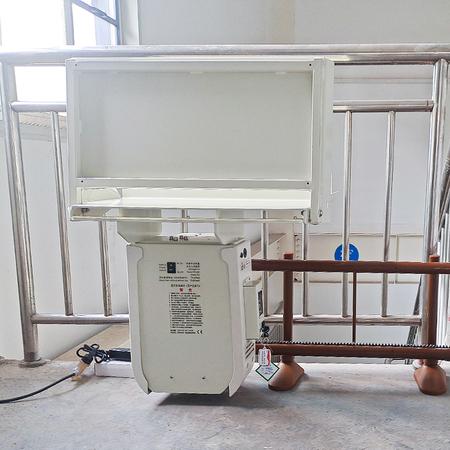
What Risks Appear In High-Frequency Commercial Use?
Commercial environments push equipment harder than residential settings. Multiple staff members may operate it, shift schedules run early or late, and different types of packages go on the platform. Over time, small issues add up. Loose rail fasteners, worn drive gears or dirty safety sensors can create hidden hazards.
Human error is another factor. Operators might stack goods unevenly, let packages hang over the platform edge, or try to carry passengers alongside cargo. This type of lift is built for goods, not people, and mixing users and loads creates a serious hazard. Site rules should clearly separate pedestrian stair traffic from lift operation zones where possible.
Dust, moisture and temperature swings in warehouses also affect performance. A lift placed near loading doors needs regular cleaning of tracks and sensors. Ignoring small signs such as unusual noise, slow response or delayed braking can turn minor wear into a dangerous failure.
FAQ About Cargo Stairlifts For Commercial Settings
1. Can I run a cargo stairlift multiple times every working day?
Yes, commercial-rated models are engineered for repeated cycles. The limit is not usually how many trips you make, but whether you stay within the load rating and follow inspection schedules. Light-duty residential stair platforms are not built for this rhythm and will degrade quickly under heavy daily use. A proper commercial version can handle dozens of cycles each day when maintained.
2. Does insurance or local code require regular inspections?
In many regions, inclined lifting platforms used for business fall under lift and access equipment codes. Local requirements vary, but periodic inspections by qualified technicians are common. Inspections verify brake function, anchor integrity, sensor response and control logic. Keeping service records also helps if you have an incident or an insurance review. Skipping inspections often voids coverage and creates compliance issues.
3. Can I place any type of goods on the platform?
No. Loose items that cannot be secured, overhanging loads and materials that shift during travel are risky. Liquids that can spill, sharp objects that may damage sensors and very tall unstable stacks are poor choices. The platform is sized for stable, contained loads. You should define what items are approved and train staff to reject any load that looks unbalanced.
4. What maintenance tasks keep the lift safe long term?
Basic routine work includes wiping sensor surfaces, checking rail bolts for tightness, testing the emergency stop and listening for abnormal vibration. A service visit will cover deeper checks on the drive system, brake wear and electrical connections. Most operators set a quarterly visual check plus a full service once or twice a year, adjusted based on how heavily they use the lift.
5. Is it possible to retrofit a cargo stairlift onto almost any staircase?
Not every stairwell is a good fit. Very tight curves, weak masonry walls, narrow landings or irregular step heights may rule out a safe install. A site survey maps out clearances, anchoring options and travel path before any equipment is selected. If the survey flags structural limits, you may need a different material handling solution instead.