
You’ve probably walked past a wheelchair lift at a store or office entrance and never thought twice about it. But behind that unassuming platform sits a whole set of rules, and for a building owner they’re not optional. Let me walk you through how a wheelchair lift actually lines up with ADA access rules, and what you should be checking before you install or buy one.
Here’s the short version up front. ADA isn’t a style guide. It’s a legal standard that says public and commercial buildings have to be usable by people in wheelchairs, without them needing to ask for help at the door. A lift is one of the cleanest ways to deliver that when a ramp simply won’t fit. The details are where the real work happens.
What ADA actually expects from an entrance
The Americans with Disabilities Act requires places open to the public—stores, offices, clinics, restaurants—to make their goods and services accessible to people with disabilities. In practical terms that means a person in a wheelchair has to be able to get in, move around, and use the space on their own.
At the entrance, that usually comes down to one question: can someone roll in without assistance? If there’s a step or a raised landing, the building needs a solution. ADA generally prefers a ramp when one can be built, because a ramp lets the user move under their own power the whole way. But ramps need a long run to stay within the allowed slope, and a lot of buildings don’t have the room. That’s exactly the gap a wheelchair lift fills—it carries the vertical change in a compact footprint instead of spreading it across the sidewalk.
Where a wheelchair lift fits, and where it doesn’t
A wheelchair lift is the right call for small to moderate height changes: a couple of steps at a storefront, a raised entryway, a stage, or a split-level corridor. You’re usually talking about a few feet of travel, and the lift handles it in a tight space a ramp could never fit.
It’s not the right tool for every situation, though. If you need to move people many feet up or across a large area, a ramp or a full elevator is usually the better answer. The lift is best understood as the space-saving option for smaller elevation changes, not a substitute for a full vertical-transport system.
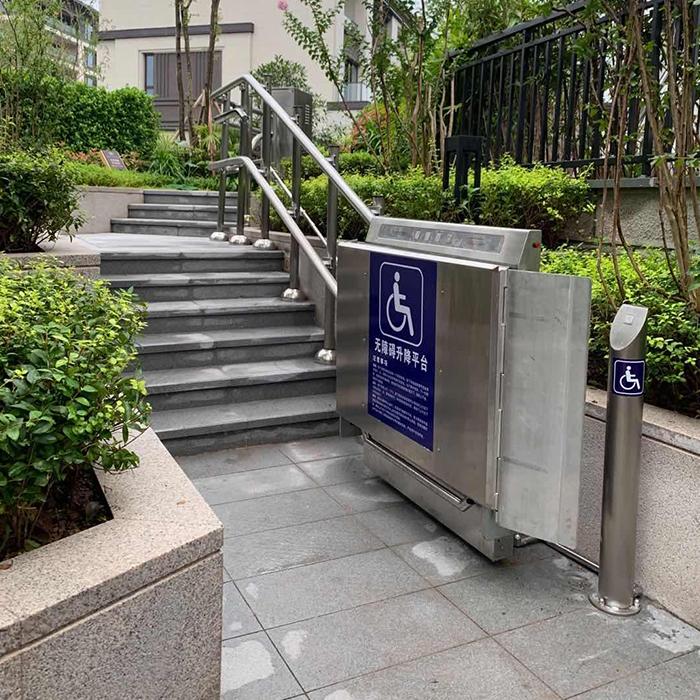
The compliance checklist—what the lift actually has to do
Meeting ADA access rules isn’t about the lift looking modern. It’s about a specific list of behaviors the lift has to deliver reliably, every time.
– Independent operation.The user has to be able to call the lift, ride it, and leave it without staff help. If a person can’t use it alone, it fails the basic accessibility test.
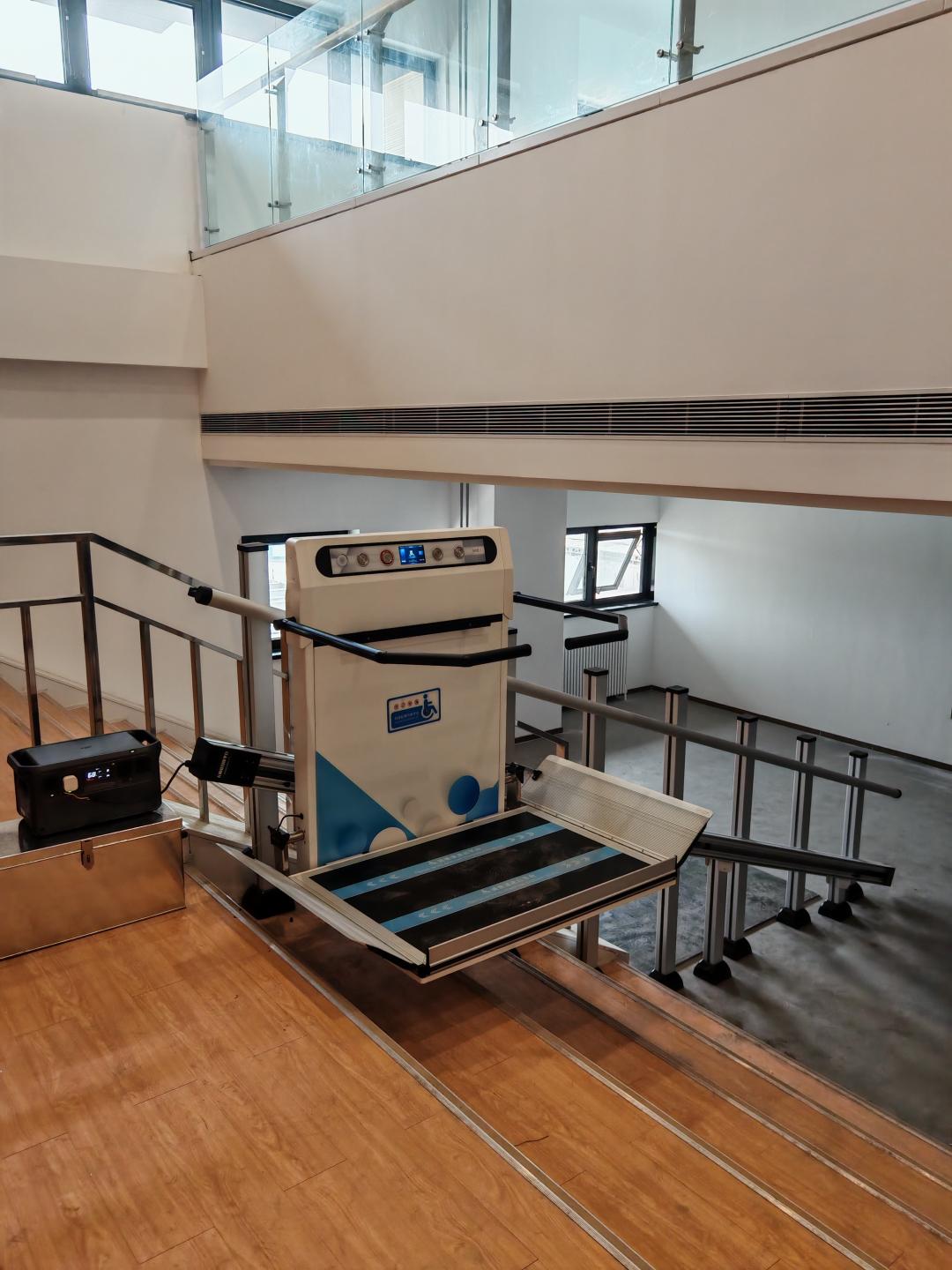
– Adequate platform.The platform has to hold a wheelchair comfortably, with room to roll on and off without squeezing the user or catching wheels.
– Rated capacity.The lift must carry the user plus their equipment, with headroom for the real weight of a power chair and its batteries.
– Reachable controls.Buttons and switches have to sit within the reach range of a person seated in a wheelchair—not mounted high where they’d need help.
– Safety devices.Gates, guardrails, and edge protection keep the user and passersby safe during travel. Many units add a manual emergency lowering so nobody gets stranded.
– Level landings.The lift has to meet the floor flush at both ends, so rolling on and off is smooth and safe.
Platform size and capacity
Two numbers drive most of the decisions. Platform size tells you whether the unit can actually hold a wheelchair, and capacity tells you whether it can hold the weight. A typical single-occupant platform runs around 30 by 48 inches, and the rated load is usually set to handle a wheelchair user plus equipment. If you’re spec’ing for a heavy power chair, confirm the capacity before you commit—underrating it creates a safety and compliance problem at once.
Controls and reach
ADA reach ranges are the part people overlook. Controls need to be usable by a seated person, within reach both forward and from the side, and operable without tight grasping or pinching. That sounds obvious, but it rules out a surprising number of “off the shelf” switches. A compliant lift has its controls designed around the person using it, not around whoever installed it.
A quick look at typical specs
These are typical reference values for a commercial wheelchair lift, not an official ADA spec sheet. They’ll vary by unit and configuration, but they give you a fair baseline for comparison.
| Parameter | Typical reference value |
|---|---|
| Rated capacity | 750 lb (single occupant + equipment) |
| Platform size | about 30 x 48 in |
| Vertical travel | 2 to 12 ft typical |
| Controls | Within seated reach range, no tight pinch/grip needed |
| Safety features | Platform gates, guardrails, edge protection, manual emergency lowering |
| Power | 110V AC, optional battery backup |
| Landings | Level and flush at top and bottom |
A couple of honest notes here. The 750 lb figure is a common rating, but always verify against the unit you’re buying and the actual weight it will carry. And “compliant” isn’t a single box to tick—it’s the sum of platform, controls, safety, and installation all working together. Skip one piece and the whole setup falls short.
What a ramp does that a lift doesn’t
It’s worth being honest about the difference. A ramp offers a continuous path a person can roll along under their own power, with no moving parts and nothing to maintain beyond the surface. That’s why ADA prefers a ramp when space allows. A lift adds moving equipment, power, and maintenance to the equation—but it earns its place by fitting where a ramp cannot. For tight sites, that trade-off is what makes accessibility possible at all.
Frequently asked questions
Is a wheelchair lift the same as an ADA-required ramp?
A: No. ADA prefers a ramp where one can fit, because it lets the user move independently across the full distance. A wheelchair lift is the allowed alternative when site space won’t accommodate a compliant ramp run.
Does the user need help to operate it?
A: Under ADA, the lift has to be independently operable by the person in the wheelchair. That’s why reachable controls and self-service operation are compliance requirements, not conveniences.
Do I need a permit to install one?
A: Usually, yes. A lift is part of the building, so it typically goes through local building code review and inspection alongside any other vertical-transport equipment. Check with your local authority before ordering.
How much weight does it need to handle?
A: A common rated capacity is 750 lb, enough for a wheelchair user plus equipment. If the user relies on a heavy power chair, confirm the specific unit’s capacity to be safe.
What keeps it compliant over time?
A: Regular inspection of gates, edge sensors, limit switches, and any battery backup, plus documented maintenance. A unit that was compliant on day one can fall out of compliance if parts wear and nobody checks.