Power outages are never convenient, but there’s one question that keeps stairlift owners up at night: will my chair elevator still move when the lights go out? The short answer is yes—if it’s set up the way it should be. Let me explain how that actually works, because there’s more to it than a battery sitting in the motor housing.
Here’s the honest part first. A chair elevator is an everyday machine that plugs into a normal household outlet. But the whole design is built around one assumption: nobody should ever get stuck halfway up the stairs because the grid hiccupped. So the real engineering question is what happens the second that outlet goes dead, and that’s what this article walks through.
How a chair elevator runs on normal power
On a typical day, the unit runs off standard house current. You plug it into a regular outlet, and the motor drives a rack-and-pinion or gear system that carries the seat up and down the rail. Power is drawn only while the unit is actually moving, so it doesn’t eat electricity sitting idle at the landing.
That sounds unremarkable, but it matters for one reason: the motor isn’t the only thing wired into the unit. There’s a second power source hidden in the system, and it exists for exactly the moment we’re worried about.
The battery backup—what it actually does
Every modern chair elevator includes a rechargeable battery pack that sits on the unit and stays topped up while the lift runs on house power. When the mains supply drops, the unit automatically switches over to the batteries and keeps working. No button to press, no reset to find—it just continues the ride.
The batteries do more than keep the motor turning. They also power the safety systems—the sensors, the stopping mechanisms, and the controls—so the unit behaves exactly the same during an outage as it does on a normal day. That’s the part people usually overlook.
Why the batteries matter more than people think
Batteries age. A pack that handled a dozen full trips when it was new can be down to a fraction of that after a few years, especially if the unit has been through hot summers and cold winters. A chair elevator that “has backup” in name can still strand a rider if nobody checked the battery health. This is why periodic testing isn’t a luxury—it’s what actually keeps the outage promise real.
What happens the moment the power drops
When the mains cut out mid-ride, the unit detects the loss and transfers to battery power almost instantly. The ride continues to the landing, often at a slightly reduced speed to stretch the battery. On many units you’ll see a small light or indicator letting you know you’re running on backup. The safety features—sensors, edge detection, the brake—stay active the whole time, so nothing about the ride changes except the power source.
If the unit is parked at a landing when the outage hits, nothing happens at all. It simply stays put, and the next time someone calls it, it runs on battery just fine.
Manual release and emergency lowering
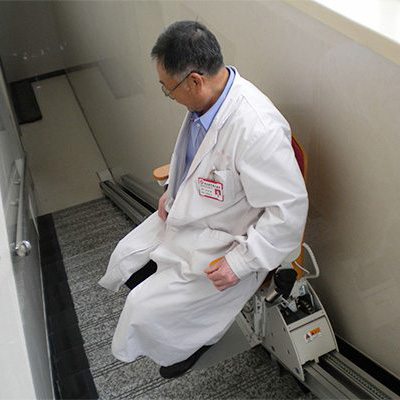
Battery backup is the first line of defense, but it’s not the only one. Every chair elevator also carries a manual release—usually a lever or a small keyed crank—that lets you lower the seat to the nearest landing without any power at all. This is the true fallback. If the batteries are completely drained, a family member or caregiver can still get the rider safely down.
It’s worth knowing where the manual release is before you need it, not during. Most units fold the rail or seat away, which keeps the staircase usable even when the lift isn’t moving.
A quick look at typical specs
These are typical reference values for a residential chair elevator, not a brand-specific spec sheet. They vary by model, but they give you a fair baseline.
| Parameter | Typical reference value |
|---|---|
| Drive power | 110V AC household supply |
| Backup power | Rechargeable batteries, auto-charging |
| Auto switch | Instant AC-to-battery transfer |
| Backup range | Enough for several full trips |
| Ride on backup | Reduced speed, safety systems remain active |
| Battery pack | 24V system typical |
| Emergency lowering | Manual release / crank to nearest landing |
Two honest notes. The backup range depends heavily on battery age and weight, so treat “several trips” as a healthy-pack figure, not a guarantee. And the manual release is a mechanical backup—it doesn’t depend on the batteries, which is exactly why it matters.
What to check to stay ready for an outage
A chair elevator only helps if it’s ready when you need it. A short checklist keeps it that way:
– Test the batteries.Run a full trip on backup power periodically, and replace packs that are clearly aging.
– Find the manual release.Know where the lever or crank is and that it moves freely.
– Keep the rail clear.Folded rails and a clear path make emergency use simpler.
– Watch for warning indicators.Many units alert you when battery health drops, so don’t ignore them.
None of this is complicated. It’s the difference between a backup that’s real and a backup that’s only on paper.
Frequently asked questions
Will a chair elevator work at all during a power outage?
A: Yes. The unit switches to battery backup automatically and completes the ride. You don’t need to press anything or reset the system.
How long can it run on battery?
A: A healthy pack typically provides enough power for several full trips. Battery age and the rider’s weight affect the actual range, so test periodically.
What if the batteries are old?
A: Old batteries lose backup range and can leave the unit without its safety net. Regular testing and replacement keep the outage promise intact.
Do I need to do anything during an outage?
A: Usually not—the unit handles the switch itself. Just keep the manual release accessible as a fallback in case the batteries are completely drained.
Is it safe to stop midway during an outage?
A: Yes. The brake and safety systems stay active on battery power, and you can use the manual release to lower the seat to the nearest landing.