
Getting up and down stairs becomes harder as people age, and many older adults end up limiting their movement at home to avoid falls. Most traditional home upgrades like full residential elevators are too expensive and require major construction work. For aging households wanting simple, safe, and affordable mobility support, a seat elevator is one of the most practical solutions available today.
The Growing Mobility Crisis in Aging Residential Properties
Aging in place has become the top choice for elderly homeowners across most countries. Instead of moving into assisted living facilities, millions of seniors prefer staying in their familiar family homes. However, most older residential buildings were not designed with elderly mobility in mind, creating hidden safety risks and daily inconveniences.
Stairs are the biggest hazard in aging homes. Joint pain, weak muscle strength, poor balance, and slow reaction speeds make stair climbing the leading cause of domestic falls among seniors. Many elderly people gradually become confined to single floors, unable to access upstairs bedrooms, bathrooms, or study rooms freely. This reduced mobility not only lowers living quality but also leads to mental stress and decreased physical activity over time.
Many families hesitate to renovate their homes because large-scale elevator installation requires wall breaking, shaft construction, and high long-term maintenance costs. Simple handrails and anti-slip tapes can only reduce minor risks but cannot solve the core problem of stair mobility. This is where a professional seat elevator fills the market gap for aging home transformation.
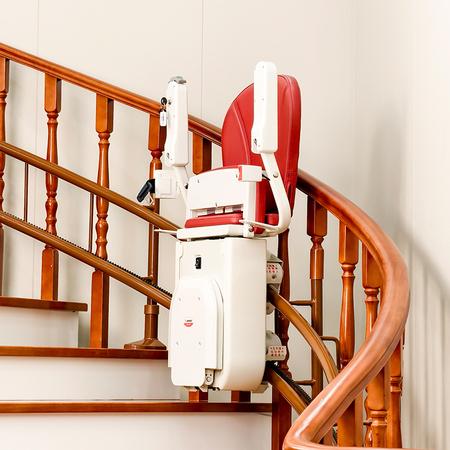
How a Seat Elevator Transforms Daily Senior Home Mobility
Different from bulky vertical home elevators and complex accessibility equipment, this compact stair mobility device focuses on solving one core problem: safe and effortless stair travel for seniors. It runs smoothly along existing indoor stair rails, requiring almost no changes to the original home structure, which makes it ideal for aging house renovations.
1. Restores Full Home Accessibility
Seniors with limited lower-body strength or balance issues can ride steadily between floors without relying on family assistance. Whether going upstairs to rest or downstairs for daily activities, users can complete independent travel, effectively avoiding the forced floor confinement problem that troubles many aging families.
2. Eliminates Major Fall Risks
Falls on stairs often lead to fractures, hospitalization, and long-term recovery for elderly people. Equipped with multiple passive and active safety designs, the device provides stable seating support and automatic speed control during operation. It completely removes the risk of slipping or tripping during stair movement, creating a reliable safe home environment.
3. Low-Threshold Home Renovation Solution
Compared with traditional home elevators that take weeks of construction and high investment, this mobility device features simple installation and low later maintenance pressure. It adapts to straight, curved, narrow, and steep stairs, covering almost all common aging home stair types. The following standard parameter table shows the core performance and configuration of mainstream household models:
|
Parameter Item
|
Household Standard Specification
|
Practical Benefit
|
|---|---|---|
|
Maximum Load Capacity
|
150kg
|
Accommodates most adult senior users
|
|
Applicable Stair Angle
|
20°–50°
|
Fits most residential stair slopes
|
|
Running Speed
|
0.12m/s (constant speed)
|
Ultra-stable operation without jitter
|
|
Drive Mode
|
Quiet gear drive
|
Low noise, no disturbance to family life
|
|
Core Safety Configurations
|
Pressure sensor, emergency stop, safety belt
|
Automatic stop under obstacle conditions
|
|
Folding Design
|
Full foldable track and seat
|
Saves stair space for other family members
|
Long-Term Benefits of Installing a Seat Elevator for Aging Homes
The value of this mobility device goes far beyond temporary convenience. For families with elderly members, it is a forward-looking home aging adaptation investment. First, it greatly reduces family care pressure. Caregivers no longer need to assist with stair travel every time, effectively reducing labor burden and accompanying risks.
Second, it protects the mental health of seniors. Independent mobility helps elderly people maintain self-confidence and a sense of independence, avoiding negative emotions such as inferiority and depression caused by long-term dependence on others. Additionally, a well-maintained seat elevator can increase home accessibility value, improving the overall practicality and market competitiveness of aging residential properties.
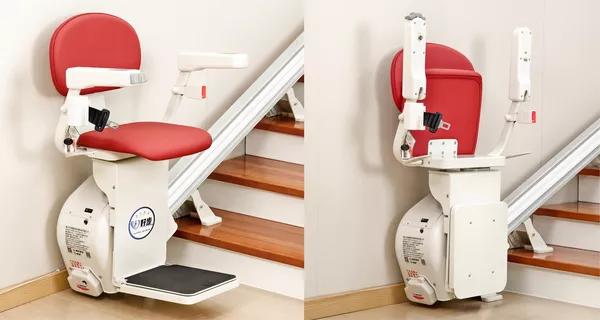
FAQs About Seat Elevator for Aging Home Mobility
1. Can a seat elevator fit narrow residential stairs in old houses?
Yes. Most household models support full folding design. After folding, the seat and track occupy minimal space, reserving enough width for pedestrians to pass normally. It is specially optimized for narrow stairs in old aging homes.
2. Is daily operation of a seat elevator difficult for elderly users?
The device adopts one-button simple operation with no complex settings. The control buttons are large and sensitive, suitable for seniors with slow response or unsteady finger flexibility. Most models also support remote control for easier use.
3. Does installing a seat elevator damage wall and stair structures?
No major damage occurs. The track is fixed on stair treads or side walls with professional fixing parts, no wall chiseling or large-scale reconstruction is required, and the original home decoration and structure can be well preserved.
4. How frequent is the daily maintenance for a seat elevator?
The equipment has a mature and simple mechanical structure with ultra-low failure rate. Users only need to keep the track clean and check the power supply regularly. Professional maintenance once or twice a year is enough to ensure long-term stable operation.