
If you are looking for a way to move a wheelchair or mobility scooter up and down a staircase that is not perfectly straight, this is probably the first question you will ask. Straight stair setups are simpler and easier to plan for, but curved, L-shaped and U-shaped stairs are common in older homes, churches, schools and many commercial buildings. It is easy to assume that these winding layouts rule out platform lifts entirely, but that is not always the case.
How Curved Stair Installations Differ From Straight Setups
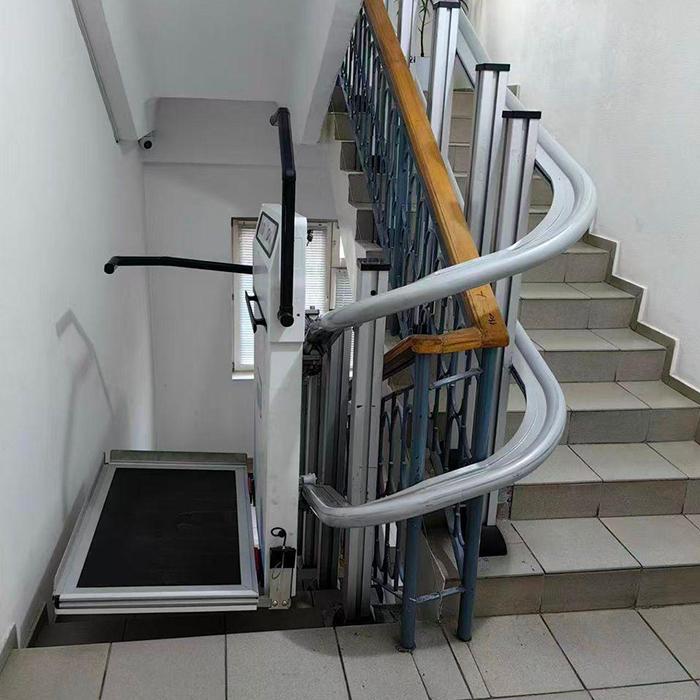
A standard straight rail can only follow one fixed angle. When stairs include turns, landings or changing radii, every section of the rail must be shaped to follow the exact path of the stair stringer. This means the rail is not built from off-the-shelf modular pieces. Each rail is measured, mapped and fabricated to match the unique geometry of the stairway.
An inclined platform lift for stairs built for curved runs still carries the same basic function: it creates a stable, level surface for wheelchairs and passengers. The main difference sits in the guide rail, drive system and control programming. The carriage must smoothly track through bends without tilting the platform or jamming against the stair edges. Engineers will check minimum clearance at every turn point, the radius of each bend, headroom and the strength of the wall or stair stringer where the rail anchors.
The table below lists typical working parameters for curved inclined platform lift systems for reference. These figures reflect widely accepted industry ranges and do not represent fixed limits for every site.
| Parameter | Typical Range For Curved Stair Models |
|---|---|
| Rated Load Capacity | 225 kg – 300 kg |
| Operating Speed | 0.06 m/s – 0.10 m/s |
| Suitable Stair Inclination | 7° – 45° |
| Maximum Continuous Travel Length | Up to 25 m |
| Standard Power Supply | Single-phase 230 V AC |
| Backup Operation | Battery backup for power failure |
It is important to note that tighter bends may reduce the usable platform width. Some very sharp spiral stairs or narrow winding flights may not have enough space to fit the folded platform and safety arms. A site survey is always required before moving forward with design work.
Key Factors That Determine If Installation Is Feasible
Not every curved stair will work. The first check is physical space. Even when the rail can bend along the stair, there must be room for the folded platform, safety barriers and sensors at both landings. If the top or bottom landing is cramped, the lift may not park safely when not in use.
The structure that supports the rail is another critical point. Rails are anchored to stair stringers or load-bearing walls. Weak plaster, hollow partitions or rotted timber cannot hold the dynamic weight of the moving platform. Surveyors will confirm anchor points and add reinforcement where it is needed.
Local accessibility codes and safety standards also shape the design. These rules cover platform size, edge protection, obstruction detection and emergency controls. Curved layouts often need extra attention because the path of travel changes direction, creating more spots where a person or object could be caught between moving parts and fixed surfaces.
Practical Tradeoffs Of Curved Lift Systems
Compared with straight versions, curved rail systems usually require longer lead times. The custom rail takes time to measure, manufacture and finish. Installation also tends to be more complex because every anchor and bend must align precisely.
When budget and timeline are important, many people first explore whether a landing could split the curve into two separate straight flights. Two straight lifts can sometimes deliver the same accessibility outcome with simpler maintenance and faster delivery. This alternative is worth discussing during the site assessment.
Frequently Asked Questions
Does a curved inclined platform lift run slower than a straight model?
Most curved units use a conservative speed setting for safety. While the motor hardware can match straight models, installers often set lower travel speeds around bends so the control system has more time to react to obstructions. The speed will stay consistent along the full route once programmed.
Can it fold out of the way when not being used?
Yes. Curved systems retain automatic folding platforms and safety arms. When parked at the top or bottom landing, the platform folds upward to leave the stairway open for foot traffic. The design must account for clearance at the curve so folded parts do not stick into the walking path.
What happens if there is a power outage mid-travel?
Nearly all modern curved inclined platform lift designs include battery backup. If mains power fails, the unit can still move slowly to the nearest landing so passengers can exit safely. An emergency stop button and manual lowering feature are also standard.
Is maintenance different for curved rail versions?
Routine checks include the same items: sensors, safety edges, battery health and lubrication. The curved track needs extra inspection points at bends. Debris can collect in curved guide channels, and wear patterns on rollers may look different from straight rails. Regular service helps avoid unexpected jams.
Final Tips Before Booking A Site Survey
Start by taking clear photos of the stair from top, bottom and each turn. Note any fixed obstacles such as handrails, radiators, door frames or low ceilings. This helps the assessment team prepare before they arrive.
Be ready to share what you plan to carry. A small manual wheelchair has different space requirements from a heavy mobility scooter. This information directly affects the minimum platform size and the load rating that the design must meet.