
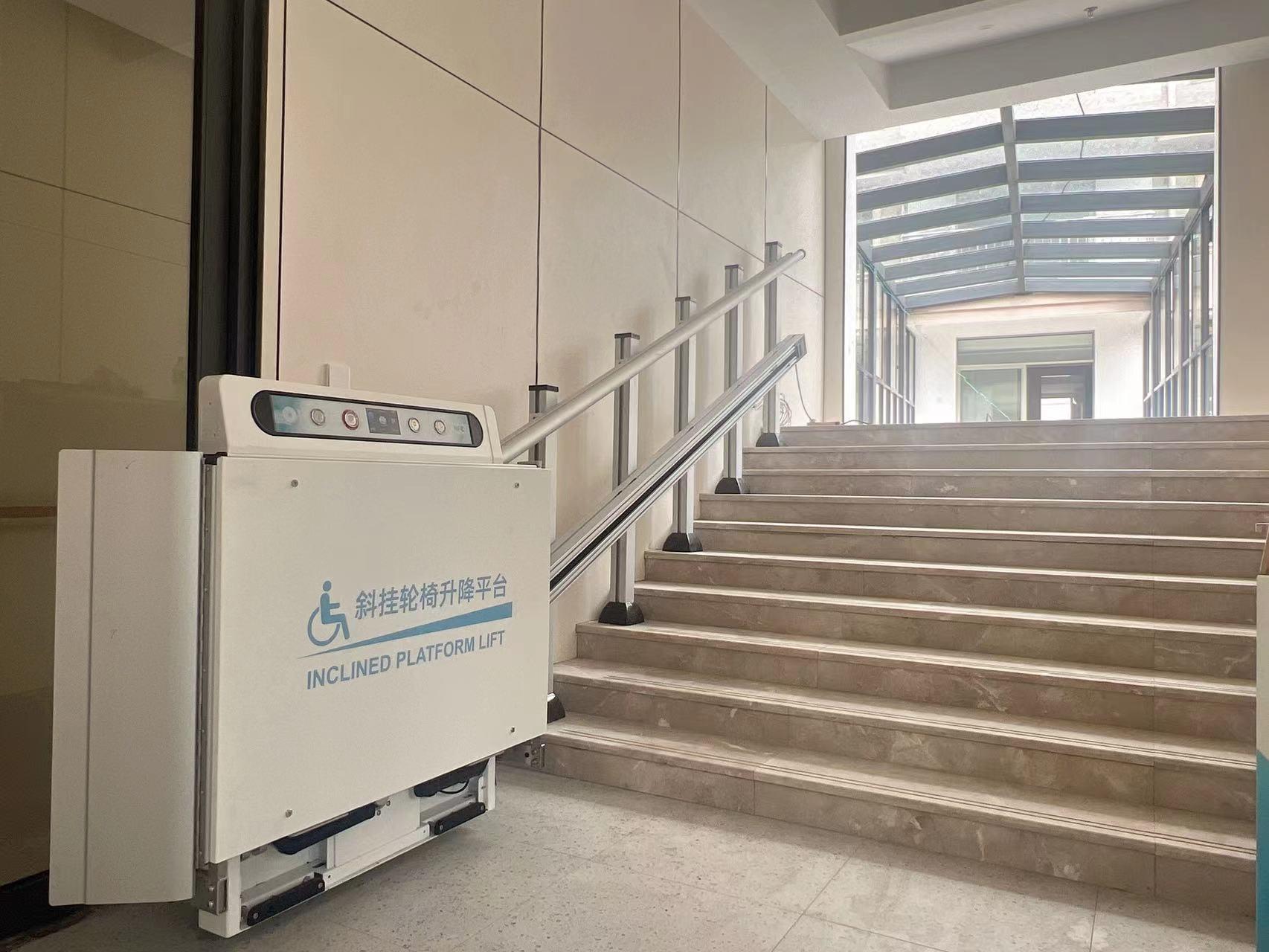
Commercial inclined platform lifts follow regional accessibility codes and mechanical safety standards. Ratings vary between base models and upgraded configurations. The most common commercial options fall between 250 kg (550 lbs) and 300 kg (660 lbs). Some regions have separate minimum requirements for public spaces, so local building codes always take priority over general product data.
| Parameter | Standard Commercial Rating | Heavy-Duty Commercial Option |
|---|---|---|
| Rated Weight Capacity | 250 kg (550 lbs) | 300 kg (660 lbs) |
| Suitable Stair Angle | 20° to 45° | 20° to 45° |
| Typical Platform Dimension | 800 mm × 1250 mm | 800 mm × 1250 mm |
| Power Supply | 208–240 VAC, 50/60 Hz | 208–240 VAC, 50/60 Hz |
| Safety Overload Protection | Built-in sensor stop | Built-in sensor stop |
| Primary Application | Offices, libraries, small public venues | High-traffic public buildings |
Keep in mind that the lift’s structural safety factor is calculated well above the published rated load. That buffer protects internal gears, rails and safety sensors, but it does not mean operators should regularly load the platform beyond the printed limit. The rated number is the safe working load for repeated daily cycles in commercial settings.
How Load Rating Connects To Accessibility Compliance
A commercial inclined platform lift installed in a public building must match local accessibility standards. Many accessibility guidelines reference a minimum design load to accommodate standard power wheelchairs plus the user. A basic manual wheelchair may weigh around 15–25 kg, while heavy-duty power wheelchairs can reach 150 kg or higher. Adding the user’s weight quickly brings the total close to the platform’s limit.
This is why high-traffic locations often choose the 300 kg rating. It creates extra room for larger mobility devices and personal belongings without hitting the load limit on every trip. Even if a lift is physically able to lift more, operating past its rating voids safety assumptions and may fail inspection during routine code audits.
Frequently Asked Questions
Can I Add Extra Weight If The Passenger Is Light?
No. The rated capacity is a fixed mechanical limit for the whole platform assembly. The system’s overload sensor measures total weight, not passenger weight alone. A light user with a heavy power wheelchair can still exceed the limit. Staff training should focus on total combined weight rather than estimating only the person’s weight.
Does Curved Stair Installation Change The Weight Capacity?
Most commercial inclined platform lifts keep the same published weight rating for straight and curved stair setups, as long as the rail and support brackets are sized for that rating. Curved track designs place different stress patterns on guide rails, so the installer must confirm the whole system is matched to the selected load class. You cannot upgrade capacity after installation by simply changing a control setting.
Will Regular Maintenance Affect The Lift’s Working Capacity?
Routine maintenance keeps overload sensors, drive gears and safety brakes working correctly, which preserves the lift’s designed capacity. Worn rollers or dirty weight sensors may cause false overload stops or, worse, fail to detect actual overloading. Following the service schedule ensures the lift performs to its original specification for years.
Is There A Difference Between Commercial And Residential Load Ratings?
Yes. Residential inclined platform lifts often carry lower weight ratings and are built for fewer daily trips. Commercial models are engineered for continuous public use, more start-stop cycles and stricter inspection requirements. A residential unit should never be relocated to a public building even if its label looks similar.