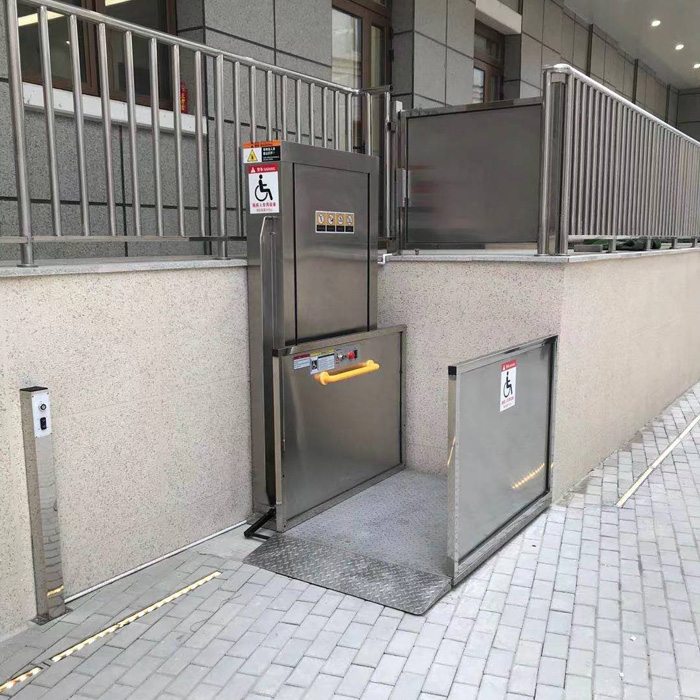
Today, with the continuous improvement of accessible facilities, the Vertical Wheelchair Elevator, as a core device that connects different floors and breaks down barriers, is gradually entering various scenarios such as residential buildings, public buildings, medical institutions, etc., providing a safe, convenient, and autonomous vertical travel experience for people with limited mobility. It is different from traditional manned elevators and simple ramps. With targeted design, flexible installation methods, and reliable operational performance, it has become an important support for protecting the travel rights of disabled people, elderly people, and other groups, allowing everyone to equally enjoy the right to use space and demonstrating social inclusiveness and warmth.
Vertical wheelchair lift platform is essentially a mechanical and electrical equipment that safely lifts a platform carrying wheelchairs and passengers to the desired floor in a vertical or nearly vertical direction along a fixed track or guide device. Its core value lies in achieving “point-to-point” vertical accessibility. Compared with traditional passenger elevators that require larger shaft space and complex structures, wheelchair lift platforms are usually designed more compactly and have relatively lower requirements for retrofitting existing building structures. They are particularly suitable for installation in existing buildings and are a common solution for barrier free retrofitting of historical buildings or space limited areas. According to the installation environment and specific requirements, its main types include: stair lift platforms installed on the side of stairs and running along the slope of the stairs; A well or column platform that can be vertically raised and lowered indoors or outdoors, either against walls or independently; And a low-level platform designed to address small height differences such as stages and podiums. There are various driving methods, such as hydraulic drive for smooth and powerful performance, screw drive for self-locking safety, or traction drive for high efficiency and energy saving, all of which require professional selection based on lifting height, load capacity, and frequency of use.
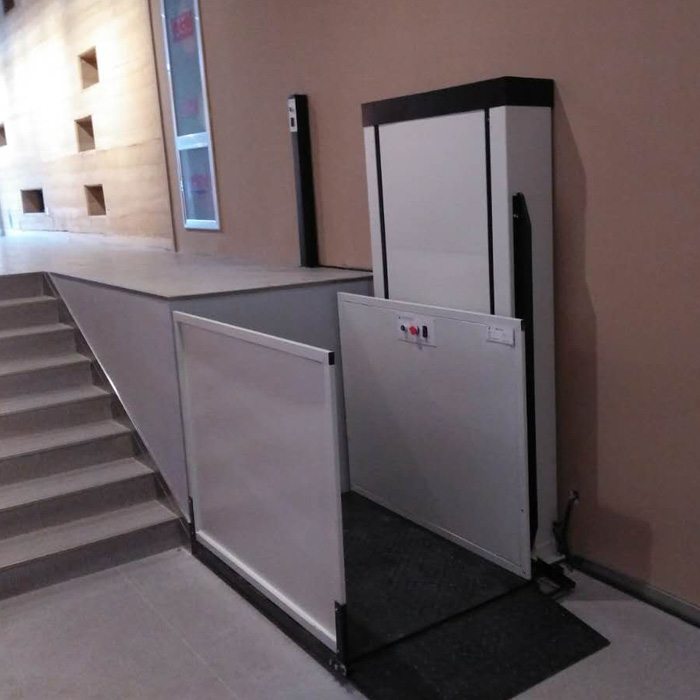
According to different usage scenarios and structural designs, Vertical Wheelchair Elevators are mainly divided into multiple types, each with its own suitable application scenarios to meet different usage needs. Among them, the enclosed Vertical Wheelchair Elevator adopts a cable design, enclosing the lifting platform and drive system inside the cabin, equipped with automatic sliding doors and safety locks, which can effectively resist the influence of external weather, suitable for outdoor installation, and ensure the privacy and safety of users. It is commonly used in private residences, office building entrances and other scenarios. The open Vertical Wheelchair Elevator has no walls or ceilings, similar to an open balcony elevator. It has a simple structure and moderate cost, suitable for scenes with small height differences, such as low rise building balconies, small shop entrances, etc. It is easy to install and does not take up too much space. In addition, there is a freight type Vertical Wheelchair Elevator, mainly used for transporting wheelchairs and heavy items, such as medical equipment in medical institutions and heavy objects in warehouses. It has strong load-bearing capacity and usually uses durable steel structures to ensure stable operation.
The application scenarios of the Vertical Wheelchair Elevator are very extensive, covering multiple fields such as private life, public services, medical health, etc., fully meeting the travel needs of people with limited mobility. In private residences, its installation allows family members with limited mobility to freely travel between different floors without relying on others’ assistance, enhancing their autonomy and sense of happiness in life. It is particularly suitable for families with elderly and disabled people, allowing them to enjoy a convenient life at home. In public buildings such as schools, office buildings, shopping malls, parks, etc., the provision of Vertical Wheelchair Elevators is an important manifestation of implementing accessibility requirements, allowing people with limited mobility to participate in social activities on an equal footing, and access to public spaces is no longer restricted by floor levels.