
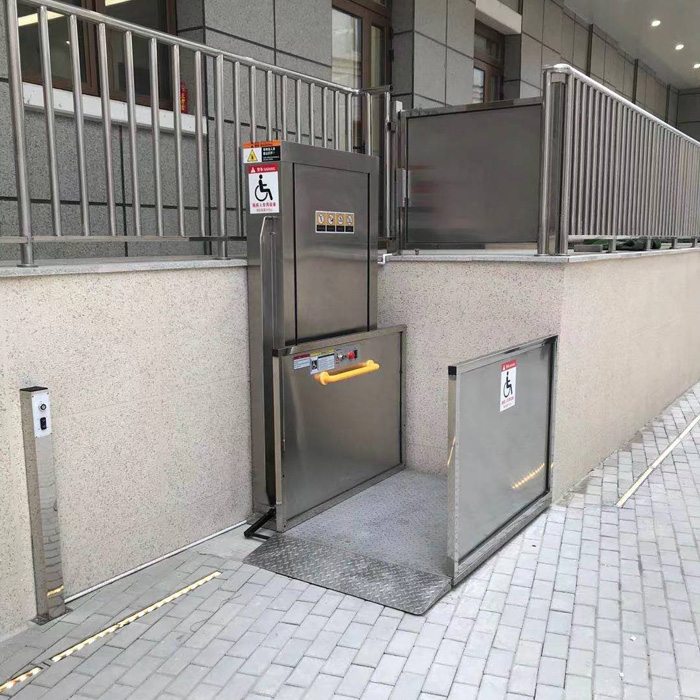
In modern architecture and public facility construction, barrier free access and efficient space utilization have become important design concepts. Vertical platform lifts, as key equipment to implement this concept, are widely used in diverse scenarios such as residential, commercial, and public transportation hubs due to their flexible adaptability and reliable safety performance. It breaks the limitations of traditional elevators on installation space and structural conditions, providing convenient channels for people with limited mobility and vertical transportation of goods, and becoming an important link connecting different floors and eliminating spatial height differences. From the barrier free renovation of old residential areas to the convenient facilities configuration of large shopping malls, from the terrain connection of scenic spots to the cargo transportation of industrial sites, the design and application of vertical platform lifts always revolve around the core goals of “safety, convenience, and adaptability”, demonstrating their unique practical value.
The core value of vertical platform elevators is first reflected in their profound practice and physical implementation of the concept of “accessibility”. In public buildings, historical sites, multi story residences, and various work environments, stairs and traditional ramps are sometimes difficult to implement or cannot fully meet the needs due to space, cost, or structural limitations. Vertical platform elevators have become an ideal choice for bridging the gap between floors due to their relatively compact footprint and lower civil engineering requirements. It provides a stable and wheelchair friendly lifting platform, allowing users to move independently and with dignity between different floors. This process is not only a simple vertical displacement, but also a way to grant equal use of space. It breaks down the social and psychological barriers caused by physical barriers and effectively promotes the inclusiveness and humanization of the environment. Its smooth operation, reliable safety protection devices (such as safety barriers around the platform, interlocking door systems, and multiple safety sensors), and intuitive operating interface jointly ensure the safety and peace of mind during use.
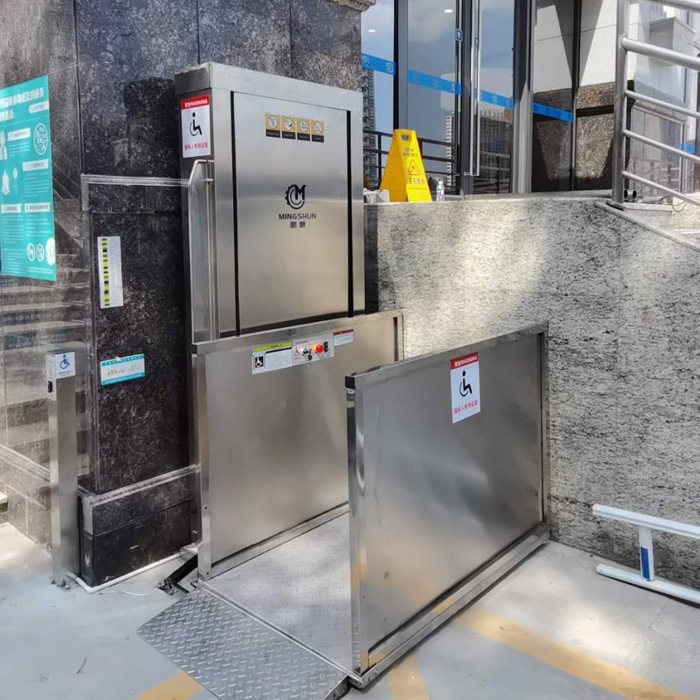
Based on the differences in application scenarios and functional requirements, Vertical platform lifts have formed a diversified classification system. From the perspective of structural form, it can be mainly divided into two types: fixed and mobile. Fixed vertical platform lifts often adopt embedded or attached installation, suitable for fixed places such as residential and office buildings, and can be perfectly integrated with building structures to improve space utilization; Its rated load capacity is usually not less than 250kg, and the lifting height can be flexibly adjusted according to the building requirements, accurately matching the height difference requirements of different floors. Mobile vertical platform lifts, with their flexible and maneuverable advantages, are widely used in temporary work scenarios such as municipal maintenance and logistics warehousing. By equipping them with mobile chassis and support legs, they can be quickly deployed in different locations to meet temporary vertical transportation needs. In addition, according to the form of protection, it can also be divided into enclosed and open types. Enclosed equipment has good wind, dust, and rain resistance, and is suitable for outdoor or complex environments; Open devices pay more attention to spatial transparency and are suitable for installation and use in small indoor spaces.
From a technical implementation perspective, vertical platform elevators integrate the wisdom of mechanical engineering, electrical control, and safety design. Its driving methods are diverse, including hydraulic drive (providing smooth and powerful lifting) and screw drive (compact structure, relatively easy maintenance). The core safety concept runs through: the system is usually equipped with devices to prevent overload, emergency systems that can safely land in case of power failure, and mechanical locking mechanisms to prevent accidental movement of the platform in non level positions. Its operation relies on a precise guide rail system to ensure that the lifting process is always precise, stable, and without significant shaking. For outdoor installation models, additional factors such as wind and rain resistance, weather resistance, and corrosion prevention need to be considered to ensure the long-term reliable operation of the equipment under various climatic conditions. The stacking of all these technical details is aimed at maximizing convenience while minimizing potential risks, and building a robust and reliable vertical transportation solution.