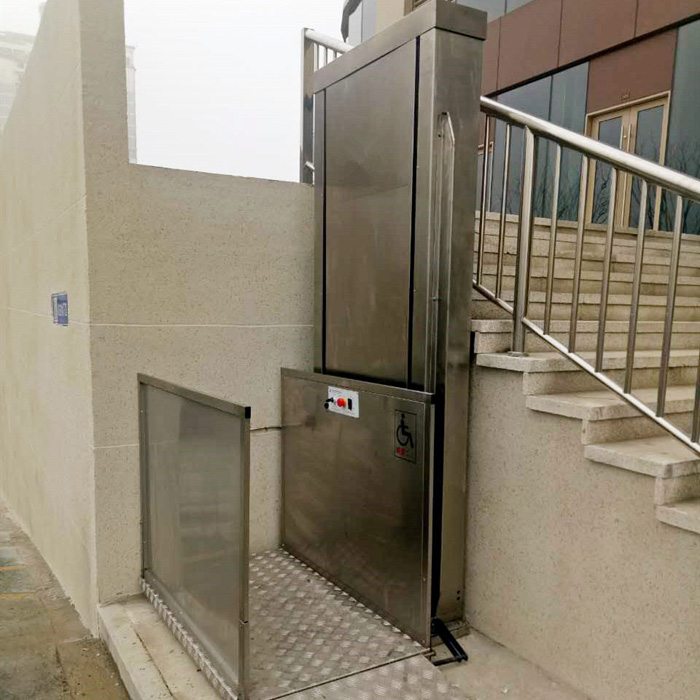
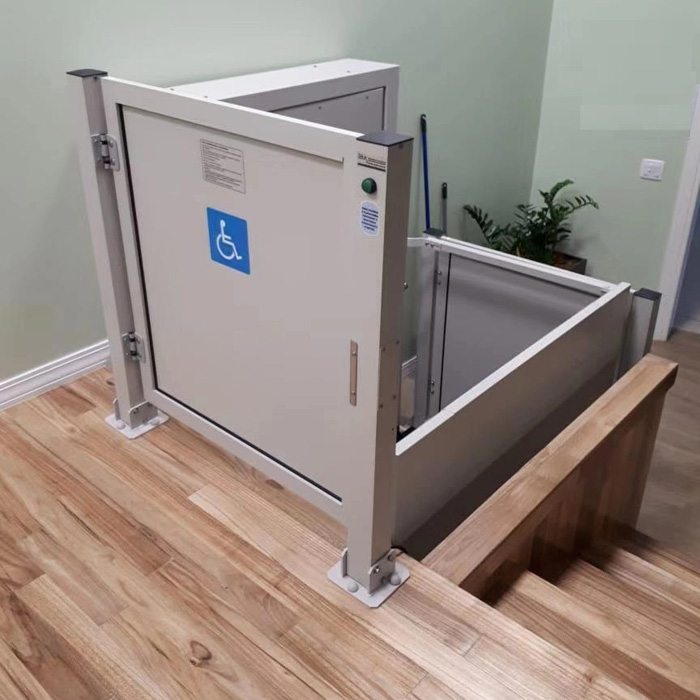
Vertical movement has always been a fundamental and critical requirement in the built environment constructed by humans. When steps and slopes cannot meet the transportation needs of everyone, a mechanical device specifically designed for vertical transportation of personnel and equipment exhibits its unique value – vertical platform lifts. They typically do not pursue high-speed or high-capacity transportation, but focus on providing safe, stable, and accessible vertical connectivity solutions within limited spaces. The existence of such devices goes beyond mere functionality and becomes an important manifestation of the inclusiveness, accessibility, and humanistic care of architectural spaces.
The most prominent advantage of vertical platform lifts is their flexible installation and adaptation capabilities. Compared to traditional elevators that require pre-set dedicated shafts and occupy larger spaces, the installation conditions of vertical platform lifts are more relaxed. They can be directly installed in idle spaces such as indoor and outdoor walls and stair sides, without the need for large-scale structural renovation, greatly reducing the installation of door sills and construction costs. At the same time, its size specifications can be customized according to actual needs, from small household accessible platforms to large industrial cargo transfer platforms, which can accurately match the traffic and transportation needs of different scenarios. In addition, the operation mode of Vertical platform lifts is simple and intuitive, and the operation panel design is user-friendly. Whether it is the elderly, people with limited mobility, or ordinary staff, they can easily grasp the operation methods, further improving the convenience of use.
From a technical implementation perspective, modern vertical lifting platforms are a refined combination of mechatronics integration and safety engineering. There are various driving methods, including smooth power brought by hydraulic drive, or precise positioning and self-locking safety ensured by screw drive. The control system is specially designed with a simple and intuitive interface, often equipped with large buttons, voice prompts, or remote control devices, fully considering the needs of different users. Safety is of paramount importance in its design: the platform edge is equipped with sensitive safety touchpoints that stop immediately in case of obstruction; The entrance and exit are equipped with interlocking safety doors or fences to ensure that the platform cannot be opened when it is not accurately in place; A complete backup power supply and manual descent device ensure safe evacuation in case of unexpected power outages. These multiple protective measures work together to create a reassuring transportation environment.
The adaptation scenarios of vertical platform lifts are extremely wide, covering multiple fields such as civilian, commercial, and industrial. In civil buildings, it is often used in old residential areas, villas and other places to provide barrier free vertical access services for people with limited mobility such as the elderly and disabled, helping them easily move between floors and improving the convenience and comfort of living; In commercial places such as shopping malls, supermarkets, hotels, etc., vertical platform lifts can be installed next to stairs or cargo passages, which not only facilitates the passage of customers with limited mobility, but also assists staff in completing vertical transportation of goods, improving service efficiency; In industrial plants, it can adapt to the transportation needs of goods in workshops, warehouses, and other scenarios, achieving efficient transportation of raw materials, finished products, etc. between different floors, especially suitable for transporting goods with large volume, heavy weight, and inconvenient elevator transportation.
On a deeper level, the vertical lifting platform embodies a people-oriented technological philosophy. It does not pursue the scale and speed of transportation, but focuses on solving specific individual difficulties, eliminating the exclusion and isolation caused by physical barriers through the sophisticated application of technology. It objectifies the concepts of equality, dignity, and independence into a set of mechanical devices that can smoothly rise and fall. Every smooth operation not only completes a physical position transition, but also empowers the user’s autonomy and is a concrete practice of social inclusiveness.
With the continuous improvement of society’s requirements for barrier free access and space utilization efficiency, the design and manufacturing technology of Vertical platform lifts are also constantly upgrading. The application of new lightweight materials has reduced the overall weight of the equipment and improved the flexibility of installation; The integration of intelligent technology enables devices to have remote monitoring, fault warning and other functions, making it easy for staff to timely grasp the operating status of the equipment and improve maintenance efficiency; The application of energy-saving technology reduces the energy consumption of equipment and is more in line with the development concept of green environmental protection. As a practical vertical transportation solution, Vertical platform lifts provide efficient and convenient support for vertical traffic needs in different fields with their flexible installation methods, reliable safety performance, and wide adaptability scenarios. They have become an indispensable equipment in modern architecture and play an important role in improving people’s quality of life and promoting the development of social accessibility.