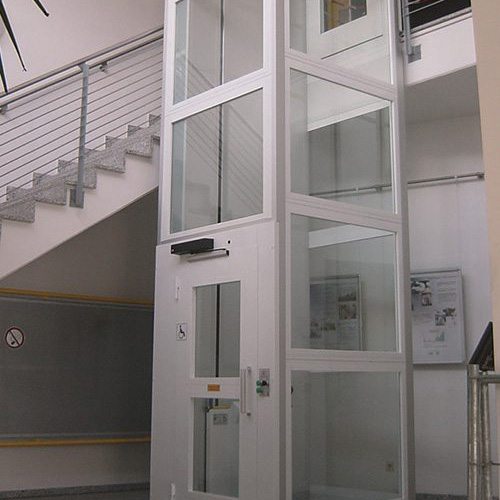
In the spatial connection and vertical transportation system of modern architecture, in addition to common elevators and escalators, there is also a key equipment that focuses on solving specific vertical traffic needs – Hoistway Vertical Platform Lifts. It is a specialized lifting platform that runs vertically along a fixed guide rail in a closed or partially closed well, mainly used for transporting people with limited mobility, goods, or equipment. Unlike ordinary elevators, the design focus of this type of equipment is to provide a limited vertical transportation solution that is safe, reliable, and accessible, with particular emphasis on adaptability to specific usage scenarios, safety redundancy, and simplicity and ease of use. Its core value lies in overcoming height differences and achieving seamless integration of architectural spaces, especially in places with rigid requirements for barrier free access or specific transportation such as old building renovations, medical rehabilitation institutions, libraries, and stage equipment transportation, playing an irreplaceable role.
The core value of Hoistway Vertical Platform Elevators is to break through floor height restrictions, build safe, smooth, and convenient vertical passages, balance accessibility needs and practical functions, provide equal access rights for special groups of people, and enhance the convenience of transportation for ordinary people and goods, adapting to the personalized needs of different buildings.
The implementation of its core functions closely conforms to the traffic and transportation needs of various scenarios: firstly, the barrier free access function. As the core value, the Hoistway Vertical Platform Lifts adopts a gentle lifting design, with a platform area adapted to the size of wheelchairs, equipped with barrier free handrails and safety protection devices. Users do not need to bend or transfer, and wheelchairs can be directly pushed onto the platform to achieve smooth lifting, effectively solving the problem of wheelchair users, elderly people and other special groups going up and down stairs, demonstrating humanistic care; Secondly, it has convenient transportation function. Compared with traditional elevators, its installation does not require large-scale renovation of the building structure and can flexibly adapt to small spaces. Whether it is residential corridors, shopping mall corners, or factory workshops, it can be customized and installed according to needs. At the same time, it is easy to operate and does not require professional personnel. Both ordinary people and special groups can easily get started, improving traffic efficiency; Furthermore, there is a safety protection function. The equipment is equipped with comprehensive safety protection devices, including emergency stop buttons, anti fall devices, anti pinch devices, limit switches, etc., which can effectively avoid safety hazards during the lifting process and ensure the transportation safety of personnel and goods.
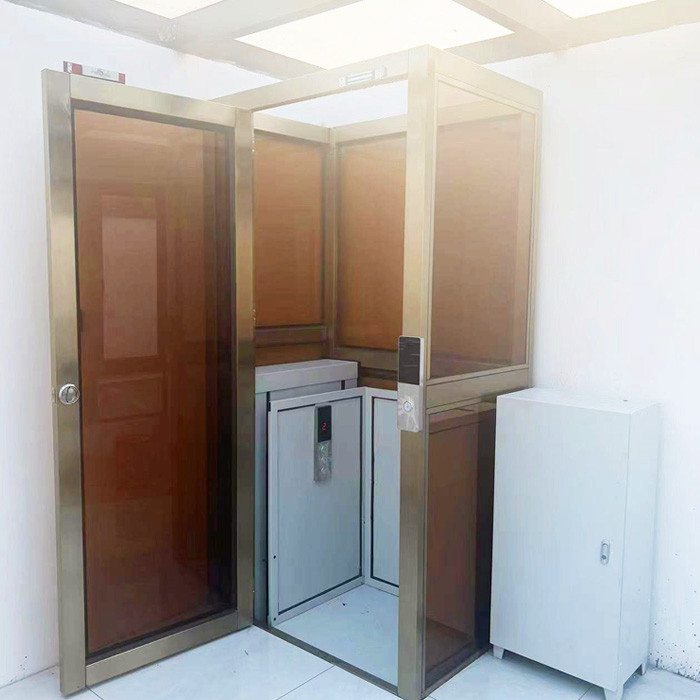
The realization of high quality and long lifespan of equipment relies on the full process control from key component selection, precision manufacturing to strict testing. Structural components such as columns, guide rails, and platform frames need to be made of high-strength steel and undergo anti-corrosion treatment (such as hot-dip galvanizing or high-quality spraying) to cope with different environments. The core components of the hydraulic system (pumps, valves, cylinders) or the motors and screws of the screw drive system should be selected with high reliability products to ensure long-term stable operation. Safety components such as fall protection devices and door lock mechanisms must undergo strict type tests to prove that they meet or even exceed relevant safety standards. All electrical components must have a good level of protection and be suitable for possible dust or moisture environments.
The Hoistway Vertical Platform Lifts have strong adaptability, with different specifications, structures, and designs according to different usage scenarios, building structures, and load requirements, which can meet the personalized vertical traffic and transportation needs of various buildings. In the field of accessible facilities, such as hospitals, nursing homes, and rehabilitation centers for the disabled, shaft type vertical platform elevators are the core accessible supporting equipment. They are usually driven by hydraulic pressure, have a large platform area, and are equipped with accessible handrails, emergency call buttons, and other devices to ensure that wheelchair users, elderly people, and disabled people can safely and conveniently go up and down stairs. At the same time, they run smoothly, have low noise, and meet the quiet environmental needs of hospitals and nursing homes; In the residential field, especially in the renovation of old residential areas, the shaft type vertical platform elevator does not require large-scale renovation of the corridor structure. It can be flexibly installed on the outside or inside of the corridor to adapt to narrow spaces, solve the problem of elderly and disabled people going up and down stairs, and improve the livability of the residence. Some residences also use small screw driven platforms to balance convenience and economy.