
Against the backdrop of increasing emphasis on accessible environments in modern society, vertical transportation in architectural spaces has become a carefully considered aspect. For people who use wheelchairs, a staircase may mean an insurmountable barrier that blocks their right to equal participation in social life. In situations where elevator installation conditions are limited or only specific short distance vertical traffic needs need to be addressed, a device called the “inclined wheelchair lifts” has become a practical and effective solution for connecting spaces of different elevations with its unique operating mode. It is not a vertical elevator or a seat that slides down stairs, but rather a sloping track along the existing stairs that smoothly carries wheelchairs and users, safely transporting them to another floor.
The core advantages of Inclined wheelchair lifts lie in their flexible adaptability and compact structural design. Compared with vertical elevators, it does not require excavation of foundation pits or occupation of independent vertical space, and can be directly attached to existing stairs or ramps for installation, greatly reducing the difficulty and construction cost of site renovation. The equipment usually adopts modular design, which can flexibly adjust the body size and operating parameters according to the inclination angle (commonly 30 ° -45 °), length and width of the slope, and adapt to different types of slope structures such as straight and curved. At the same time, its compact structural design ensures that it does not excessively occupy traffic space during operation, guaranteeing the normal passage of other pedestrians, especially suitable for accessibility upgrade scenarios such as renovation of old buildings and small and medium-sized places with limited space.
The emergence and application of such devices deeply reflect the principle of “reasonable convenience” in accessible design. In buildings where traditional vertical elevators cannot be installed due to historical preservation, limited space, structural limitations, or cost considerations, such as old multi story residences, libraries, teaching buildings, churches, community centers, and even historical sites, inclined lift platforms provide a less invasive renovation solution. It does not require an independent shaft, does not occupy a large amount of space, and the installation process has relatively limited impact on the original staircase structure. However, it can substantially solve the key barrier free access problem, allowing wheelchair users to independently and with dignity reach spaces that were previously inaccessible, greatly improving the inclusiveness and usability of the building.
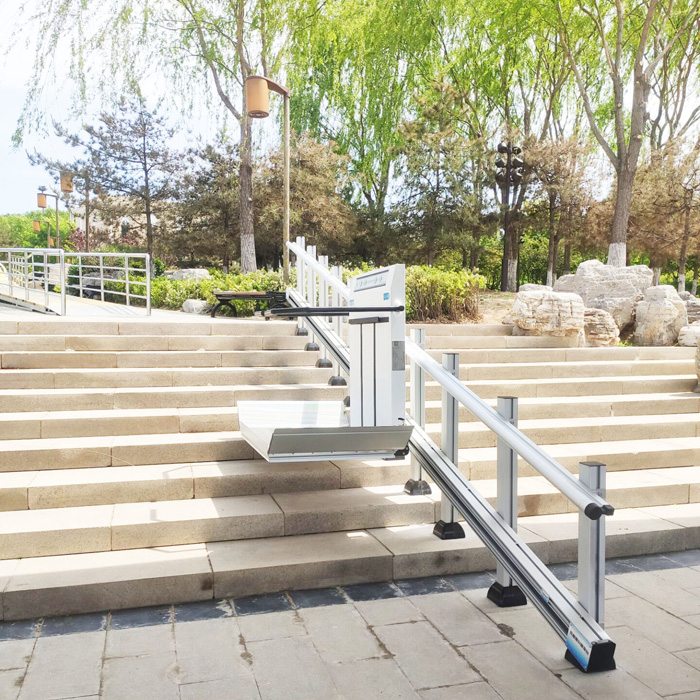
Inclined wheelchair lifts
Safety performance is the core design point of Inclined wheelchair lifts, and a comprehensive safety protection system provides users with protection. The equipment is equipped with multiple safety protection devices, including anti fall devices, emergency braking systems, anti slip platforms, etc. The anti fall device can instantly lock the lifting platform in case of abnormal equipment operation or rope breakage, preventing the platform from slipping off; The emergency braking system can automatically stop the operation of the equipment when encountering obstacles or sudden faults, reducing the risk of collision; The surface of the anti slip platform is designed with anti slip patterns, combined with safety guardrails and seat belts on both sides, which can effectively fix the position of the wheelchair and prevent users from tipping or slipping during equipment operation. In addition, the equipment is equipped with an emergency call button and a manual operation device. In case of power failure or equipment malfunction, users can seek help through emergency calls, and operation and maintenance personnel can also complete rescue through manual operation, further improving the safety of use.
In practical applications, the value of a tilted wheelchair lift platform goes far beyond completing one transport. It represents society’s recognition and response to the diverse needs of people. In public buildings, it ensures accessibility and compliance within the legal framework, reflecting the concept of equality among public service institutions. In private residences, it may completely change the living radius and independence of a person with limited mobility, allowing them to freely move between different floors of the home, which has a profound impact on their quality of life and psychological state. In educational institutions, it ensures that all students have equal access to all teaching facilities. Its significance lies in that it not only moves a person and a wheelchair, but also removes a restriction imposed by the physical environment, and is the concrete materialization of social civilization and humanistic care in the built environment.
With the continuous deepening of the accessibility concept, Inclined wheelchair lifts are also continuously optimized and upgraded. The new equipment incorporates intelligent monitoring technology, which can monitor the real-time operation status of the equipment, achieve fault warning through data transmission, and facilitate timely processing by operation and maintenance personnel; The application of lightweight and high-strength materials not only enhances the load-bearing capacity of equipment, but also further reduces its weight and reduces the load on the installation carrier; Some devices also have folding and storage functions, which can be folded and stored when not in use, further saving space. As an important enabling equipment for barrier free access, the Inclined wheelchair lifts, with their flexible adaptation, safety and reliability, continue to improve the barrier free travel network, providing convenience for the daily life and travel of people with limited mobility, and promoting the construction of a barrier free society to a higher level.
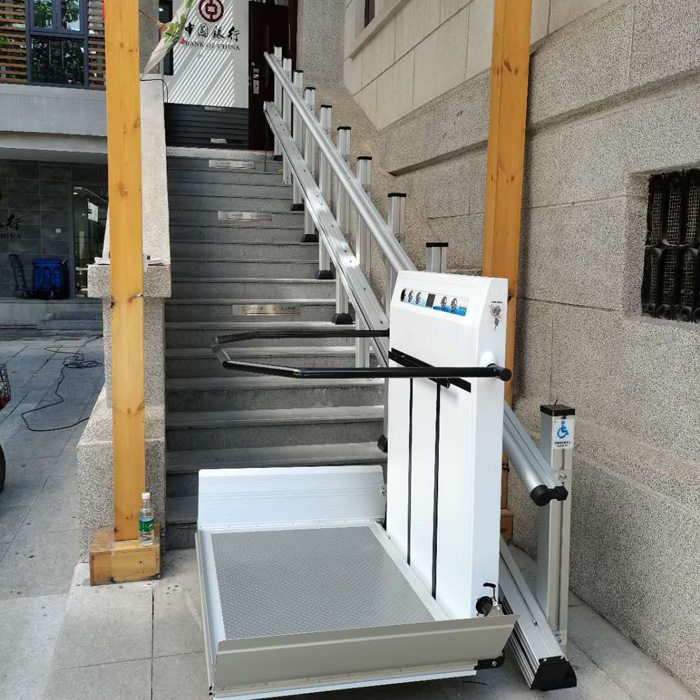
Inclined wheelchair lifts