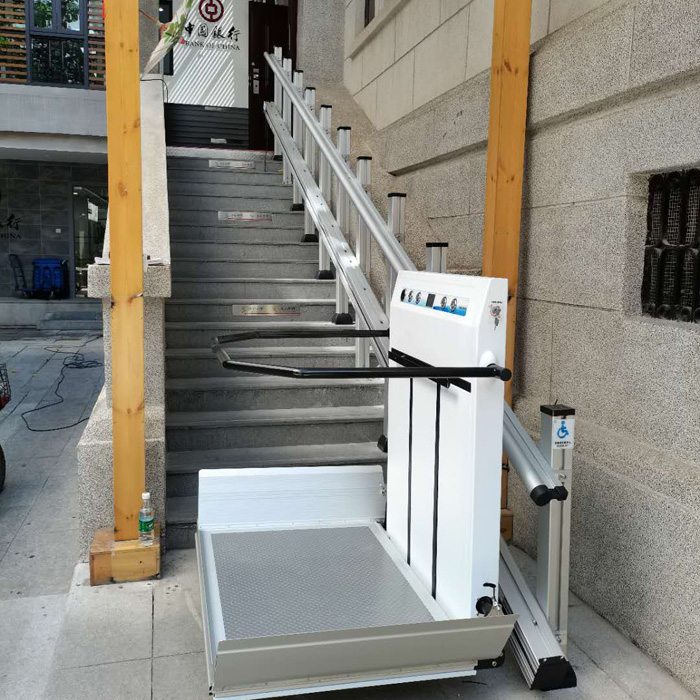
In the barrier free environment construction system, the Inclined Wheelchair Lifts have become a key facility for breaking down obstacles in stair passage due to their strong adaptability and flexible installation, and building a safe and smooth travel bridge for people with limited mobility. Whether it is the barrier free renovation of old residential areas, convenient facilities in public places, or the guarantee of access to special places, Inclined Wheelchair Lifts plays a low-key yet important role in promoting the improvement of social barrier free environments, allowing every user to enjoy equal freedom and dignity in travel. As a specialized lifting device that operates on the sloping surface of stairs, it breaks the strict spatial requirements of traditional vertical elevators and becomes an important supplement to accessible travel facilities by better fitting the characteristics of existing building structures.
The core function of the inclined wheelchair lift platform is to provide stable and reliable inclined transportation for people using wheelchairs, electric scooters, or other mobility aids along the slope of existing stairs. Unlike vertical elevators, it does not rely on independent shafts, but is directly fixed to the staircase structure through a track system, which makes it a significant advantage in space constraints or historical building renovations. The original intention of its design is aimed at a fundamental requirement: to overcome the common physical obstacle of stairs in places where traditional elevators or lifting platforms cannot be installed, and to ensure equal access rights for every user.
From the perspective of technological evolution, early inclined lifting devices were relatively simple and mainly relied on mechanical structures and basic electric drives. Although safety was guaranteed to some extent, there were limitations in terms of user experience, environmental adaptability, and intelligent control. With the continuous development of materials science, control engineering, and safety standards, modern inclined wheelchair lift platforms have evolved into highly integrated systems. Its core components, including high-strength aluminum alloy or steel tracks, smooth driving devices (such as silent worm gears or hydraulic systems), ergonomic manned platforms, and comprehensive safety protection devices, together form a reliable technological foundation. Among them, safety is highly valued: multiple braking systems, locking devices to prevent accidental platform movement, edge sensing safety touches, backup power sources, and user accessible emergency stop buttons constitute layers of protection to ensure foolproof operation.
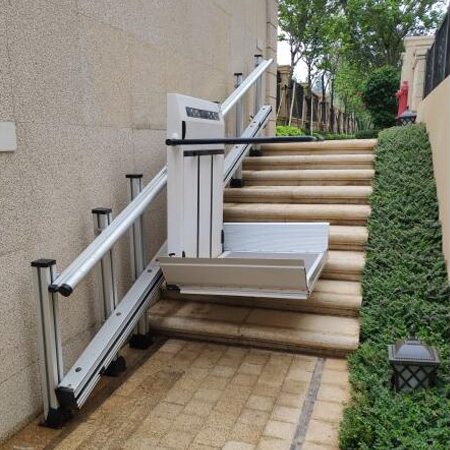
The application scenarios of Inclined Wheelchair Lifts cover multiple fields such as residential, commercial, and public services, demonstrating strong environmental adaptability. In the renovation of old residential areas, it does not require the destruction of the original building structure, and can be installed by simply installing tracks, effectively solving the spatial problem of barrier free renovation of old buildings; In public places such as shopping malls, hospitals, and transportation hubs, it can quickly connect the traffic areas of different floors, complement vertical elevators, and improve the overall level of accessible services; In special places such as schools and nursing homes, their stable operation characteristics and comprehensive safety guarantees can better meet the usage needs of the elderly and children. Some devices also have a folding function, which allows the platform to be folded upwards for storage when not in use, minimizing the impact on stair passage and further improving space utilization.
With the increasing emphasis on accessible environments in society, the technological research and development of Inclined Wheelchair Lifts is also moving towards a more intelligent and user-friendly direction. Intelligent upgrading has become an important trend, and some high-end devices are equipped with remote monitoring systems that can provide real-time feedback on device operation status and early warning of potential faults; The continuous optimization of humanized design has led to the emergence of customized track systems that can adapt to curved stairs, further expanding their application scope; The innovation of material technology has made equipment lighter and more durable, reducing installation difficulty while ensuring structural strength. These technological advancements not only enhance the user experience of Inclined Wheelchair Lifts, but also drive the development of barrier free facilities towards more precise and comprehensive directions.