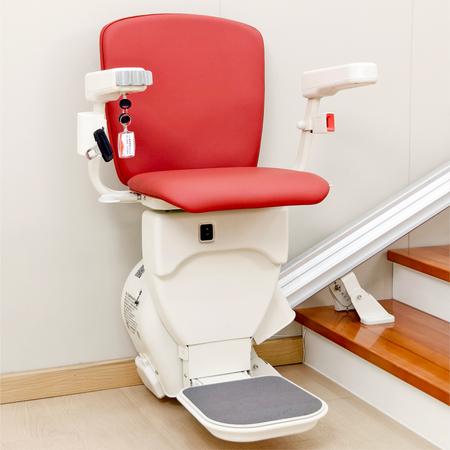
In the vertical traffic equipment system of buildings, Curved Stair Elevators are personalized traffic equipment designed specifically for irregular and curved stairs. It breaks the scene limitations of traditional linear staircase elevators, providing safe and convenient access for people with limited mobility through a track and drive system that can adapt to complex staircase trajectories such as arcs and corners, while also considering the integrity of the building structure and space utilization. Whether it is the barrier free renovation of old villas and historic buildings, or the personalized access needs of modern duplex residences and public venues, Curved Stair Lifts can become the core solution to solve complex staircase access problems with flexible adaptability and reliable performance.
The technical core of the curved staircase lift chair lies in its precise track adaptation and smooth curved movement ability. Each system needs to be personalized according to the specific geometric shape of the stairs – technicians first conduct precise 3D measurements of the stairs, recording the height, depth, corner curvature, and overall inclination of each step. These data are input into professional design software to generate a curved track scheme that fully conforms to the contour of the staircase. The track is usually made of high-strength aluminum alloy profiles, processed into a predetermined curvature through CNC bending technology, ensuring smooth lines that are parallel and equidistant from the staircase handrails or walls. This “tailor-made” customization process allows the lift chair to elegantly blend into the original building environment, avoiding the abrupt feeling often associated with adding equipment.
Compared to linear staircase elevators, Curved Stair Elevators have significant advantages in adaptability and personalized design. Due to the significant differences in the trajectory of curved staircases, each Curved Stair Lift requires customized services throughout the entire process, from on-site survey, trajectory modeling, track processing to installation and debugging, all in accordance with the specific parameters of the staircase. During operation, the precise fit between the track and the car (or platform) ensures smooth turning without any jamming or shaking. At the same time, the track design of Curved Stair Lifts takes into account space saving. When not in use, the elevator car can be folded and stored on the side of the stairs, without occupying the passage space of the stairs, ensuring that other personnel can go up and down normally. Some high-end products also have intelligent adaptation functions, which can fine tune operating parameters according to the user’s weight and operating habits, improving the user experience.
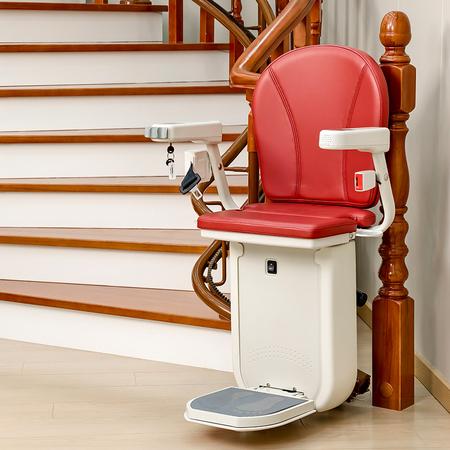
The seat design fully considers ergonomics and long-term comfort. The width and depth of the seats have been rigorously studied to provide sufficient support without excessively occupying stair space. The high-density foam filled cushion and backrest fit the human body curve, and the rotatable seat enables users to transfer easily and safely after arriving at the floor. The detailed design of folding foot pedals, adjustable seat belts, and soft armrests together create a comprehensive safety protection. Some models also offer personalized configurations such as heated seats and charging ports, further enhancing the user experience. The seat can be folded and retracted when not in use, minimizing the impact on the normal passage of stairs.
Safety performance is the core consideration in the design and application of Curved Stair Lifts, and its safety assurance system covers multiple levels such as mechanical protection and electrical control. In terms of mechanical protection, key components such as anti fall devices, anti rollover guardrails, and emergency braking systems are equipped. When the equipment experiences abnormal operation or sudden failure, the emergency braking system can be immediately triggered to lock the car on the track; The anti fall device ensures the safety of personnel in extreme situations through steel wire ropes or hydraulic buffering mechanisms. In terms of electrical control, a dual circuit design is adopted to avoid equipment shutdown caused by a single electrical component failure. At the same time, emergency call buttons, remote control operations, and other functions are equipped to facilitate users to seek help in emergency situations. In addition, the device also has obstacle detection function, which monitors obstacles in the running trajectory in real time through sensors. Once a foreign object is detected, it immediately stops running to prevent collision accidents.
The existence of curved staircase elevators has enabled many people who were previously unable to fully utilize their living space due to staircase obstacles to regain their freedom. For the elderly, rehabilitation patients, or people with limited mobility, it is not just a means of transportation, but also an important partner in maintaining autonomy, social activities, and safeguarding home safety. Its appearance often helps people avoid being forced to move out of familiar living environments and achieve the beautiful vision of “aging on the ground”. On a psychological level, the ability to independently climb up and down stairs greatly enhances the user’s confidence and sense of happiness in life, and this intangible value often goes beyond the practical functions of the device itself.